
Bringing home a puppy or kitten is an exciting moment, multiplied if you have young kids. It’s also a bigger decision than it first looks, because the breeder you choose can shape your pet’s health, temperament and happiness for years.

450,000 puppies
Sold in Australia each year based on PIAA data

85% sold
Outside pet shops—mostly online & unregulated
- According to the Pet Industry Association of Australia (PIAA), around 450,000 puppies are sold in Australia each year.
- Only approximately 15% of puppies are purchased through pet shops, and the vast majority of purchases happen online. Online sales are largely unregulated.
Here are our top tips for aspiring pet-owners who need help finding their next furry family member.
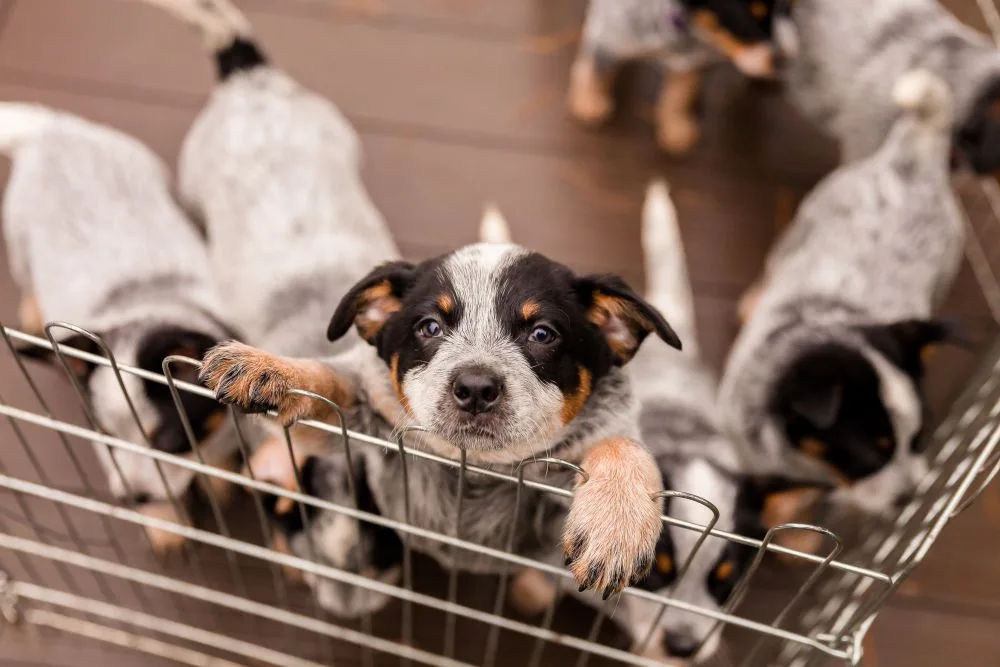
The golden rule when buying a puppy
If you take away one thing, make it this.
Always visit in person, see where the pet was raised, and meet its mother with the litter.
Every major welfare body in Australia, the UK, and the United States lands on the same point, because it defeats almost every puppy farm and online scam in a single move.
A responsible breeder will welcome the visit. A puppy farm or scammer won’t, because the conditions, or the absence of a real litter, would give them away.
When a seller wants to meet you in a car park, drop the puppy at your door, or post it interstate, take it as your cue to walk away. If the dog/cat mum isn’t there, the puppy/kitten probably wasn’t bred there.
Breeder green flags and red flags
Responsible breeders tend to behave the same way, and so do the people you want to avoid. Here’s a quick checklist to help you discern better:
| ✅ Green flags | ❌ Red flags |
|---|---|
| Invites you to their property to meet the puppy/kitten with its mum and littermates | Wants to meet in a car park, or offers to deliver or ship the pet |
| Asks you questions about your home and lifestyle | Asks you nothing and just wants a fast deposit |
| Shows health test results for both parents | Can’t produce genuine health testing or vet records |
| Won’t let the pet leave before 8 weeks of age (12 weeks for kittens) | Keen to sell unweaned puppies/kittens that are too young to separate from their mothers |
| Hands over vaccination, microchip, and worming records on vet letterhead | Pushes you to pay quickly, especially by unusual methods |
| Offers to take the pet back at any point in its life | Brushes off serious health issues as normal for the breed |
| Might have a waiting list rather than puppies always ready to go | Won’t let you see the mother or where the litter was raised |
Tip: A quick scam check for online listings: be wary of brand new websites, and never pay a deposit before you’ve visited. Puppy scams cost Australians millions of dollars a year, almost always when the buyer pays before meeting the pet.
The questions a good breeder will happily answer
A good breeder loves talking about their animals and genuinely wants them to belong to the right families, so questions are welcome. Take this short list with you.
- Did you breed this litter yourself, and can I see where they were raised?
- Can I meet the mother, and father?
- Have both parents been health tested for conditions common in this breed, and can I see the results?
- When are the puppies or kittens wormed, vaccinated and microchipped?
- At what age can my pet come home (answer should be no earlier than 8 weeks for puppies and 12 weeks for kittens)?
- Is there a health guarantee, if something unforeseen happens, will you take the pet back?
- Can you provide a written sale contract?
We partnered with some of the biggest breeder associations in Australia
Our breeder partners help us educate pet owners about dogs and cats. Read about our featured breeders!
Why should the breeder ask questions?
Responsible breeders genuinely care about their breeding animals and about the pets they are breeding. This often extends to where the pet will go when it leaves.
Responsible breeders want their puppies or kittens to go to homes where they will have a happy and fulfilling life. You may find yourself wondering why the breeder wants to know so much about your home, family and lifestyle. That’s because they want to know whether the pet will suit your lifestyle and household situation.
Don’t be offended if you are rejected by the breeder, as it’s probably for the best. The pet may be an active breed and you live in an apartment. Or a breed that loves company might not suit you if most days no-one will be home for long stretches.
Whatever the reason, the breeder isn’t rejecting you personally. They’re only letting you know that there isn’t a match.
How to verify a breeder in your state
Australia regulates breeders state by state, not nationally. Most states now issue a breeder number that must appear in pet ads. In some states, you confirm it through a public search. Start with the table below.
| State or territory | What to ask for | How you can check it |
|---|---|---|
| VIC | Source number (Pet Exchange Register), plus the pet’s microchip number | Search the source number at the Pet Exchange Register. Every for-sale ad must show the source number and the microchip number. |
| NSW | Breeder Identification Number (BIN) (B followed by 9 digits), plus microchip number | Use the NSW Pet Registry to confirm the BIN is active and the microchip matches. All puppy ads must carry a BIN. |
| QLD | Supply number from the Queensland Dog Breeder Register | Check it on the Queensland Dog Breeder Register. Dogs Queensland members are exempt and use their membership number instead. |
| SA | DACO number (the letters DACO followed by 6 digits) | Search current and past breeder numbers at dogsandcatsonline.com.au. A breeder licensing scheme is expected around 2027. |
| WA | Council details, and for cats a local council approval to breed | There is no state-wide public breeder register yet, so verify in person and at council level. Pet shops may now only sell rescue animals. |
| ACT | Breeding licence number, or microchip number plus a seller ID in the ad | There is no public online register, so confirm a licence with Domestic Animal Services directly. |
| TAS | For cats: a current cat breeding permit or membership of a recognised cat body. Dogs have no breeder scheme. | Ask to see the permit or membership card. Verify dogs only through the individual pet’s council registration and microchip. |
| NT | Council registration and microchip details | Regulation is council by-law only, so there is little to verify online. Lean hard on an in-person visit. |
Remember: The rules shift often, and Western Australia and South Australia both have reforms still being rolled out. It’s best to look up the official state government or council website for the current state of regulations.
Registration is the starting line, not the finish. A breeder number, or club membership, only confirms that someone has registered. It doesn’t prove they’re responsible or that their animals are well looked after. In-person visits and the health checks matter most.
Why health testing matters
Purebred and crossbred animals alike can inherit health problems from their parents. Responsible breeders screen their breeding stock and only breed from healthy animals, which gives your pet the best possible start and can spare you real worry and cost down the line. A crossbreed isn’t automatically exempt from this, so ask either way.
In Australia, the main schemes run through Dogs Australia. The Canine Hip and Elbow Dysplasia Scheme scores each hip, where lower is better, so a good breeder can show their dogs sit well below their breed average. The Australian Canine Eye Scheme certifies dogs against inherited eye conditions, with results logged on the national ORCHID database. Many breeds also have their own specific DNA tests.
When a breeder tells you their animals are DNA tested, do three things: ask to see the actual results, check the tests are relevant to that breed, and ask what they do about any results that come back.
⛳A confident breeder will have the paperwork ready. Vague claims with nothing to back them up are a red flag.
A note on adopting
Buying from a responsible breeder is a fine choice—so is adopting. The RSPCA encourages people to consider a shelter or rescue first, as adopted pets usually arrive already vaccinated, wormed, microchipped, desexed and health checked.
Whichever way you go, the principle is the same: deal with people who put the animal’s welfare first.
Bringing your new family member home with confidence
Choose well at the start and you can take most of the stress out of what comes later. Visit in person, meet mum, ask about health testing, and check the breeder’s number for your state. Trust your gut, because if something feels off, it usually is.
At Knose, we believe pet care should be simple, easy and affordable, and that prevention beats cure. We also know that accidents and illness can strike even the healthiest, best bred pet.
That’s why Knose Pet Insurance exists: clear cover with no nasty surprises, from a genuine pet care company rather than just an insurer. Our goal is to give you award-winning financial support you need at the right time, so you can get on with the best part: welcoming your new best friend.
Pet insurance for Australia’s favourite dog breeds
Discover why so many pet parents insure these dog breeds with Knose.